Policy Statements
A. Peer Review Process
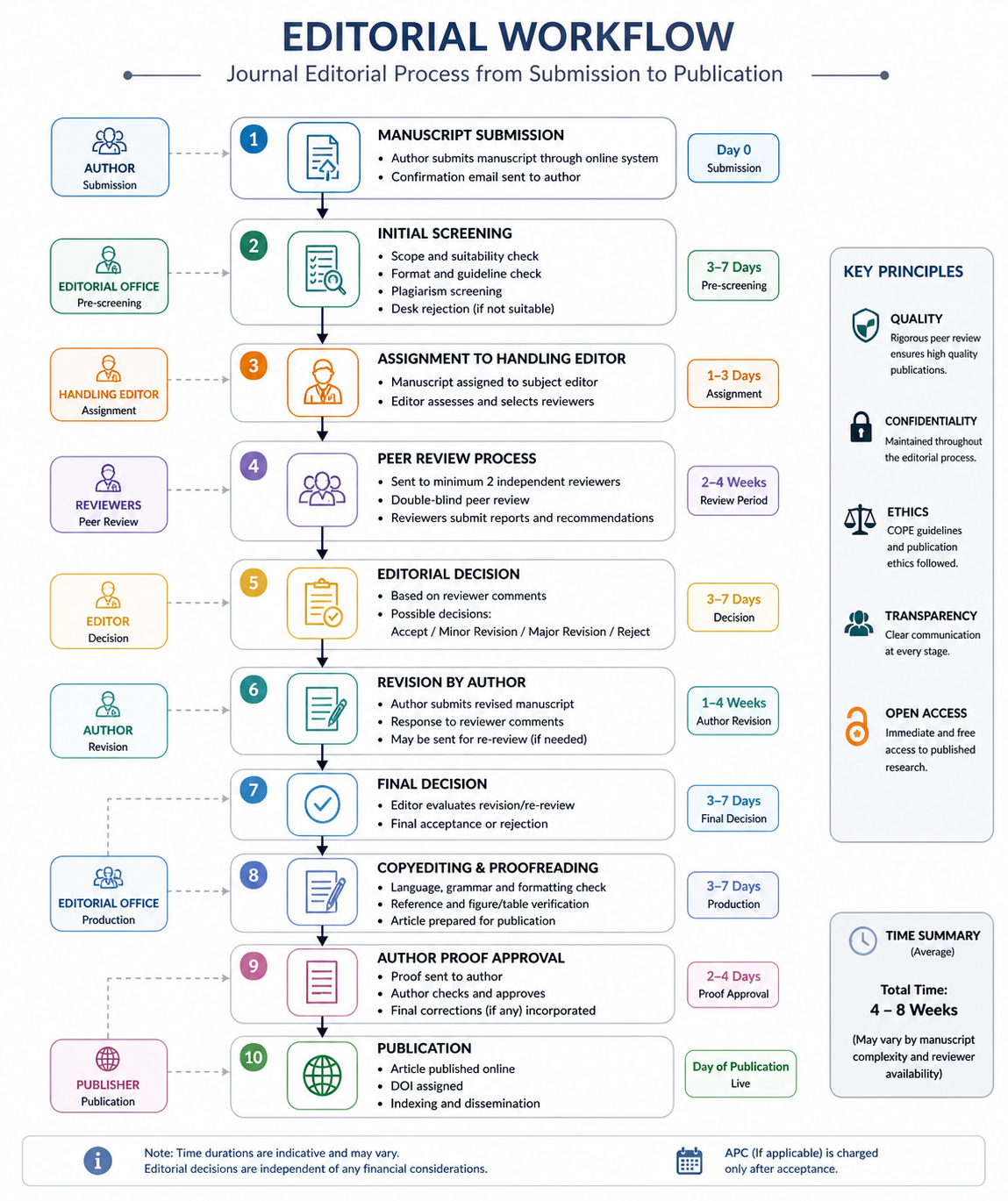
Research Ascent Medical Journal follows a double-blind peer review process to ensure the quality, validity, and originality of published research. In this process, the identities of both authors and reviewers are concealed from each other.
1. Initial Editorial Screening
All submitted manuscripts undergo an initial evaluation by the editorial office to ensure that they:
Fit within the journal’s scope
Adhere to submission guidelines
Meet basic scientific and ethical standards
Manuscripts that do not meet these criteria may be rejected without external peer review.
2. Assignment to Handling Editor
Eligible manuscripts are assigned to an appropriate handling editor based on subject expertise. The handling editor oversees the peer review process.
3. Reviewer Selection
Each manuscript is reviewed by a minimum of two independent reviewers who have relevant expertise in the subject area. Reviewers are selected based on their academic qualifications, research experience and publication record
4. Double-Blind Peer Review
Authors’ identities are concealed from reviewers
Reviewers’ identities are concealed from authors
Reviewers evaluate manuscripts based on their scientific validity, originality and novelty, methodological rigor, ethical compliance and clarity of presentation
5. Reviewer Recommendations
Reviewers provide detailed comments and recommend one of the following:
Accept
Minor revision
Major revision
Reject
6. Editorial Decision
The final decision is made by the Editor-in-Chief or handling editor based on:
Reviewer comments, Scientific merit of the manuscript, Relevance to the journal, Authors are notified of the decision along with reviewer feedback.
7. Revision Process
If revisions are requested, the authors must submit a revised manuscript along with a point-by-point response to reviewers and the revised manuscripts may be sent for re-review
8. Final Acceptance and Publication
Once accepted, the manuscript undergoes copyediting and formatting, proofs are shared with authors for final approval, and the article is published online
9. Timeline
Initial screening: 3–7 days
Peer review: 2–4 weeks
Final decision: 4–6 weeks (average)
Timelines may vary depending on reviewer availability and manuscript complexity.
10. Ethical Considerations
All manuscripts are treated as confidential documents and reviewers must declare any conflicts of interest. The journal follows COPE guidelines for ethical publishing
11. Transparency and Integrity
Editorial decisions are independent of APC payments. APC is charged only after acceptance. The journal does not guarantee acceptance of any manuscript
12. Appeals and Complaints
Authors may appeal editorial decisions by submitting a detailed justification to the editorial office. Appeals are reviewed independently and decisions are communicated transparently.
Contact
For queries related to peer review:
Email: editor@ramjournal.com
B. Reviewer Recognition Policy
Research Ascent Medical Journal acknowledges the essential role of peer reviewers in maintaining the quality and integrity of scholarly publishing. The journal is committed to recognizing reviewer contributions while preserving the confidentiality of the peer review process.
Recognition Methods
Annual Reviewer Acknowledgment:
The journal publishes an annual list of reviewers who have contributed during the year (with reviewer consent).
Certificates of Review:
Reviewers may receive a digital certificate acknowledging their contribution upon completion of a review.
Reviewer Credits:
Reviewers are encouraged to record their peer review activity on platforms such as Publons/Web of Science Reviewer Recognition (where applicable).
Confidentiality
Reviewer identities are not disclosed in relation to specific manuscripts under the double-blind peer review model. Recognition is provided without linking reviewers to individual articles.
Quality and Timeliness
Recognition is granted based on:
Completion of reviews within stipulated timelines
Quality, constructiveness, and professionalism of feedback
Editorial Board Consideration
Consistently high-performing reviewers may be considered for inclusion in the journal’s editorial board.
Ethical Standards
All reviewers are expected to adhere to COPE guidelines, maintain confidentiality, and declare conflicts of interest.
C. Artificial Intelligence (AI) Use Policy
Research Ascent Medical Journal recognizes the growing role of artificial intelligence (AI) tools in research and publishing. The journal provides the following guidelines to ensure ethical and transparent use.
Use of AI by Authors
AI tools (e.g., language models, writing assistants) may be used for language editing or formatting support only.
AI tools must not be listed as authors.
Authors must disclose any significant use of AI tools in the manuscript (e.g., in Methods or Acknowledgments).
Authors remain fully responsible for the accuracy, originality, and integrity of the content.
Prohibited Uses
AI-generated data, images, or results presented as real without disclosure
Fabrication or manipulation of research findings using AI
Use of AI to generate peer review reports under author identity
Use of AI by Reviewers
Reviewers must not upload manuscripts into AI tools or external platforms, as this may breach confidentiality.
AI tools should not be used to generate full review reports.
Use of AI by Editors
Editors may use AI tools for administrative tasks (e.g., plagiarism checks, language screening), but final decisions are made by human editors.
Transparency
All AI use must be transparent, ethical, and in compliance with publication standards and COPE recommendations.
Open Access Statement
Research Ascent Medical Journal is a fully open access journal. All content is made freely available to readers immediately upon publication, without subscription or access fees.
Users are allowed to read, download, copy, distribute, print, search, or link to the full texts of articles, or use them for any other lawful purpose, without asking prior permission from the publisher or the author.